And how they are now doing it on purpose
A customer expects to return an item. Instead, they get a message: Keep it, we have refunded you. It feels accidental. It is not. It is unit economics.
And until recently, this move has usually been handled in the worst possible way: manually, inconsistently, and without data. What merchants already know instinctively is finally becoming explicit: some returns should never enter the return pipeline at all.
The cheapest return is the one that never ships.
The bigger shift is that returns stop being a logistics problem and become a decision problem.What a €40 return actually costs
Take a typical ecommerce order priced at €40. The return can easily absorb €18 to €32 on top of the refund once shipping, handling, restocking loss, and support overhead are included.
- Return shipping: €6 to €12
- Processing and handling: €5 to €10
- Restocking or markdown loss: €5 or more
- Support time: €2 to €5
- Total: €18 to €32 on top of the refund
At that cost stack, a €10 keep offer is not a discount. It is the profitable outcome.
The problem with the current approach
Most keep-it decisions today live inside support tickets. That means no consistent rules, no fraud protection, no data, and different customers getting different outcomes for the same case.
- The decision is based on gut feel instead of rules.
- Different customers get different treatment for the same case.
- No structured reason data is captured.
- Fraud exposure goes up because exceptions are hard to track.
- Merchants miss the chance to optimize which offers actually save the order.
The shift: intercepting returns before they exist
KeepCard moves the decision earlier. Instead of waiting for a return request to become an RMA, it captures return intent at the moment a customer is about to start that process.
The same logic can run across multiple channels:
- QR card inside the package
- Return link in post-purchase email
- WhatsApp flow
- AI chatbot or support assistant handoff
Same entry point. Same logic. Same outcome model.
How the flow actually works
- 1. Customer signals intent They scan a QR code or click a return link instead of dropping straight into a return portal.
- 2. Intent is captured and verified The order is verified, and the customer selects a reason such as size, changed mind, damaged, or not as expected.
- 3. The decision engine triggers Preference-based, low-cost cases can receive a keep offer such as a partial refund, store credit, or another controlled incentive. Defects and high-risk cases continue into the standard return path.
- 4. The right outcome happens Either the return is avoided and margin is saved, or the customer proceeds to the normal return flow without extra friction.
Real data from a live store
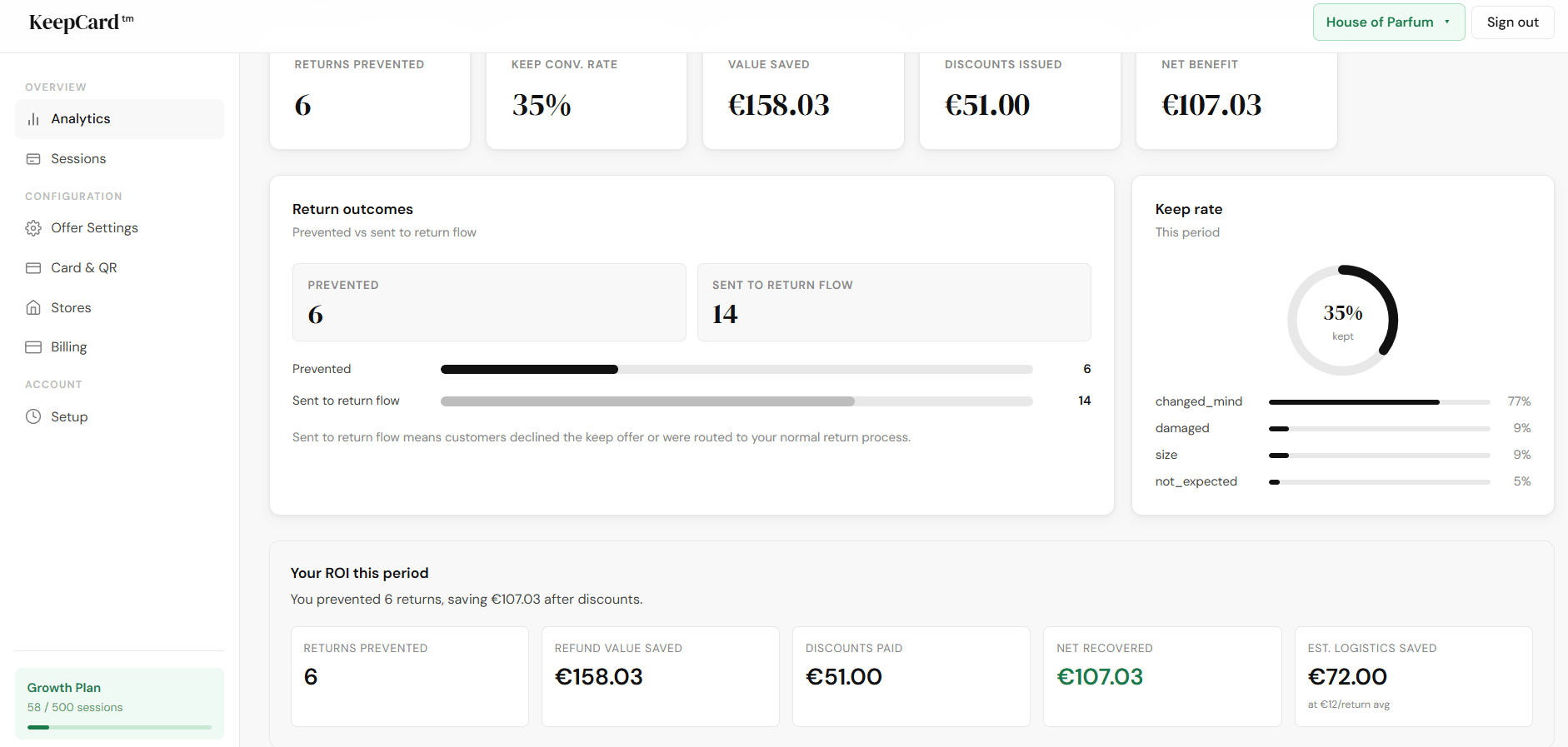
This is where the economics become concrete. In the live-store dashboard snapshot shown here, the current view shows:
- Keep conversion rate: 35%
- Returns prevented: 6
- Value saved: €158.03
- Discounts issued: €51.00
- Net benefit: €107.03
That is transaction-level evidence that early intervention changes the economics of the return flow.
Why customers say yes
Most returns are not defect claims. They are softer reasons: the item did not feel quite right, the fit was off, or expectations were slightly missed.
For these cases, many customers prefer an instant €5 to €10 back over printing a label, packing the product, shipping it, and waiting for the refund to clear. Convenience wins.
What changed
Before this shift, returns behaved like a logistics problem. The decision happened late, after cost was already locked in. With KeepCard, returns become a decision problem. The decision happens early enough for the cost to be avoided.
Why this becomes a system instead of a feature
Once the merchant controls the decision layer, several new capabilities show up at once:
- Return reason data tied to actual customer intent
- Offer optimization based on which incentives convert
- Fraud signals based on repeated patterns
- Channel consistency across QR, email, support, and chat
At that point, KeepCard stops looking like a simple returns tool and starts looking like post-purchase infrastructure.