Why Fresh Chile is setting up KeepCard before peak season.
Fresh Chile is rolling out KeepCard across packaging, email, and SMS so return intent can be handled earlier, while the brand still has the customer's attention.
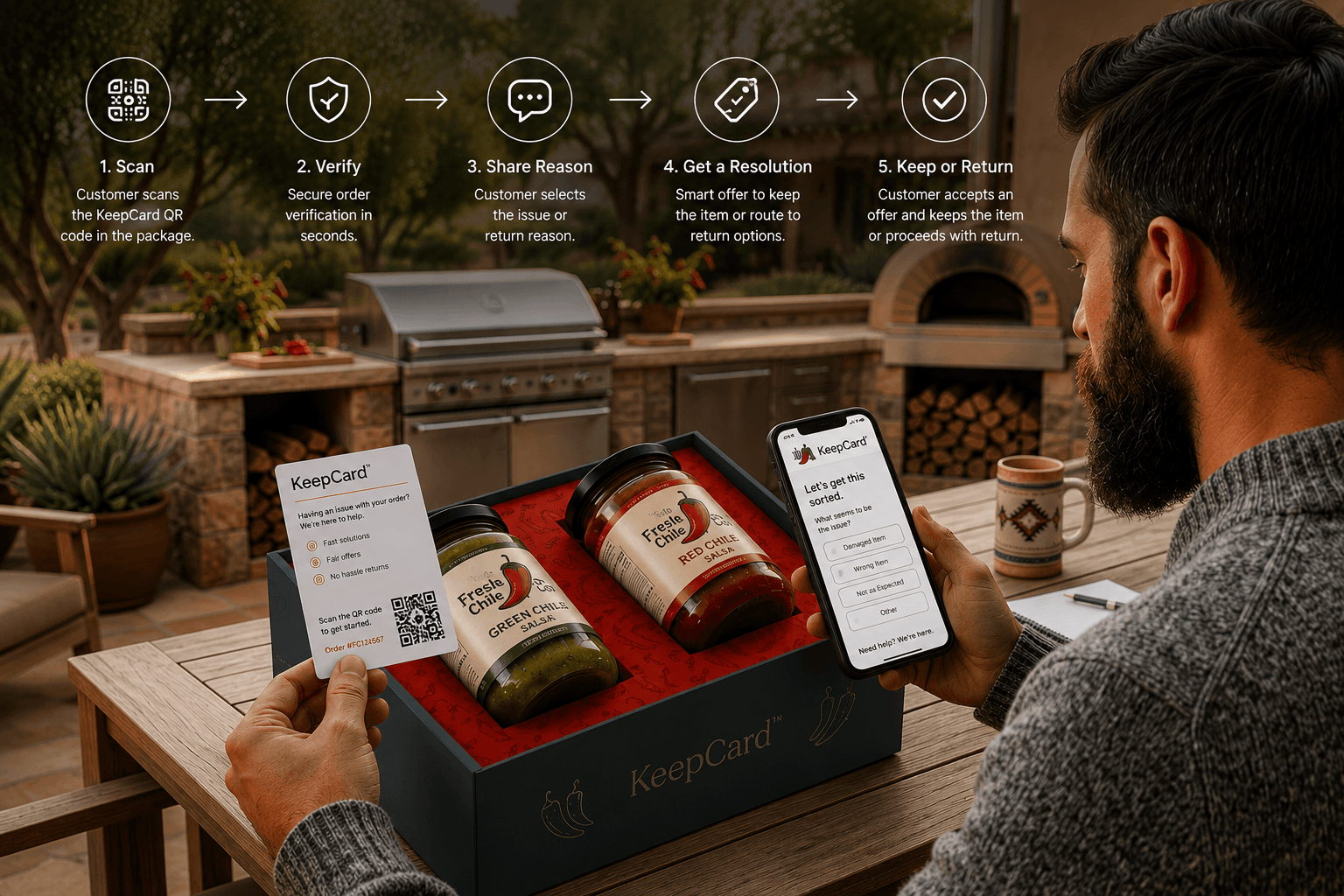
Fresh Chile already owns the post-delivery moment
Fresh Chile has already done the hard part. The brand has a clear product story, strong Shopify execution, distinctive packaging, and an active post-purchase communication engine. It is also the only company commercially producing red chile sauce from fresh red Hatch chile — a product available for just 30 days a year during harvest — which means the product already carries genuine scarcity and craft before a customer ever opens the box.
That matters because return intent does not begin inside a portal. It begins the moment a customer decides something feels off. KeepCard gives Fresh Chile a way to meet that moment before it becomes a support loop or a backward-moving package.
The strategy: interception at the tactile moment
Most brands treat returns like a customer service issue that lives on a hidden website page. Fresh Chile is taking the opposite approach by placing KeepCard where attention is highest.
- In-box QR inserts. The customer can scan while the product is still in hand, before frustration turns into a return search.
- Lifecycle email and SMS. The same path can be reinforced digitally, so the experience stays consistent whether the customer opens a box or an inbox.
- One coordinated decision layer. Fresh Chile does not have to rely on a disconnected return page as the first real touchpoint after something goes wrong.
Why this setup matters
What makes Fresh Chile a strong KeepCard account is not just the category. It is the team. They already think in segments, channels, and coordinated post-purchase flows, which means KeepCard can operate like infrastructure instead of a bolt-on tool.
- Intent segmentation. Preference-led cases can be handled differently from true product issues.
- Direct defect routing. Damaged or wrong-item cases can move straight into support without awkward offer logic.
- Fraud controls. Interactions are tied to verified Shopify orders from day one.
How the flow works
- The customer sees KeepCard in the package. The insert gives the customer a clear branded path if something about the order is not right.
- The customer can also enter through email or another post-purchase channel. That keeps the workflow consistent even when the customer starts from their inbox instead of the physical card.
- KeepCard captures the reason before a standard return begins. Changed-mind and other preference-led cases can be separated from damaged, wrong-item, or defect claims.
- Fresh Chile keeps control over the outcome. The brand can present a keep incentive where it makes sense and route true return cases into the normal process without creating support confusion.
What we are watching next
As the rollout matures, the interesting questions are straightforward:
- Do pantry orders behave differently from gift-oriented purchases?
- Do packaging inserts or digital touchpoints create cleaner completion rates?
- Which cases deserve an alternate resolution and which should route directly into support?
- How much margin is protected when a keep-style resolution beats reverse logistics?
What makes this a live blueprint, not a launch announcement
Fresh Chile is not interesting because it is installing another app. It is interesting because it is using KeepCard the way strong operators adopt new infrastructure: inside existing channels, against real customer behavior, and with a clear idea of what success should look like once volume hits.
That makes this less of a launch announcement and more of a live operating blueprint.
Strong launch conditions
- Recognisable product story. Fresh Chile presents itself as a family-owned Las Cruces business built around Hatch chile tradition, which makes post-purchase messaging feel specific instead of generic.
- Real customer proof already exists. The site highlights over 400,000 satisfied tastebuds and 7,000+ 5-star reviews, which means KeepCard would sit in front of an audience the brand already knows how to convert and retain.
- Physical shipment touchpoint. The package insert creates a durable entry point for KeepCard in a business that ships pantry products nationwide.
Operator-led omnichannel rollout
Fresh Chile can use KeepCard across both physical and digital post-purchase surfaces instead of relying on a single return entry point.
The practical advantage is consistency: the insert in the box, the follow-up email, and the SMS layer can all guide customers into the same verified resolution flow rather than creating separate support habits.
That matters more for a brand with visible breadth: 26 sauce and salsa products, 8 fresh-pepper products, 7 spice products, a paid membership offer, a 36,000+ member cooking group, and retail exposure through United Supermarkets, Market Street, and Albertsons Market.
Launch now, measurement next
Fresh Chile is setting up the architecture first, then measuring how the rollout performs across inserts, email, and SMS.
The near-term goal is not inflated claims. It is to establish a clean baseline, watch which entry points customers actually use, and learn whether early return-intent capture produces a measurable operational advantage before peak volume arrives.
For a brand that already runs an All-Access membership with 20% off every order, free shipping support, and annual store-credit mechanics, the next logical step is not more promotional tooling. It is a cleaner post-purchase decision layer that can be measured channel by channel.
Explore more
Every day your portal processes avoidable preference returns, it costs more than it should.
KeepCard adds the decision layer before that. Free setup. 14-day trial. Works with your existing return workflow, not instead of it.